
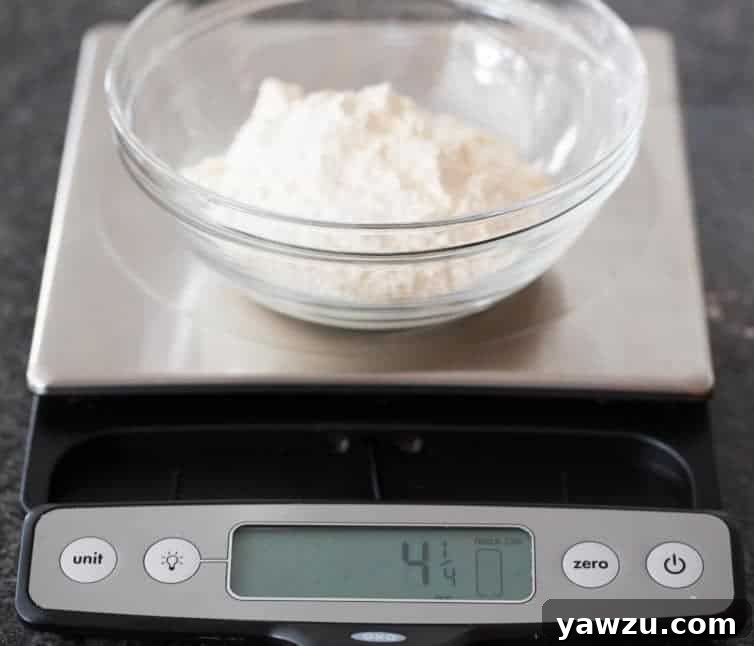
Embarking on a culinary journey, especially into the nuanced world of baking, quickly reveals a fundamental truth: precision is paramount. One of the most transformative discoveries many home cooks make is the invaluable asset of a reliable kitchen scale. Beyond mere convenience, the ability to accurately weigh ingredients and achieve precise measurements forms the bedrock of consistent and successful baking outcomes. Baking, at its heart, is a delicate interplay of science and chemical reactions, where even slight deviations can dramatically alter the final product. It was several years ago that I first championed the importance of weighing ingredients for superior baking results. Since then, while I’ve diligently incorporated weight conversions into numerous recipes, the sheer volume of inquiries, comments, and emails I continue to receive underscores a persistent confusion around ingredient weights. This consistent feedback has compelled me to revisit this crucial topic, aiming to demystify the process and empower every baker with the tools for unparalleled accuracy.
The Persistent Problem: Debunking the 8 Ounces = 1 Cup Myth
Perhaps the most common and misleading misconception circulating in the baking community, and one I frequently encounter in my correspondence, is the steadfast belief that 8 ounces universally equals 1 cup, irrespective of the ingredient. This deeply ingrained notion, often treated as an immutable law of the kitchen, is
simply not true for the vast majority of ingredients.
While this conversion holds true for certain liquid ingredients such as water and milk, and notably for butter (a unique solid ingredient that conveniently aligns with this metric), this is largely where the utility of this simplistic rule ends. The underlying issue lies in the fundamental difference between volume and weight, and the concept of density. Density refers to the amount of mass (weight) contained within a given volume. Different ingredients possess varying densities, meaning that one cup of flour will weigh significantly less than one cup of honey, and both will weigh differently from one cup of water. Relying solely on the “8 ounces = 1 cup” mantra for all ingredients is akin to assuming a cup of feathers weighs the same as a cup of rocks; it’s a recipe for inconsistency and, more often than not, baking failures.
All other solid ingredients – and even pourable, viscous substances like honey and molasses – exhibit vastly different weights per 1 cup of volume. Failing to account for these density variations can lead to a multitude of baking woes: dry, crumbly cakes from excess flour; dense, heavy breads from too much sugar; or overly wet batters that refuse to bake through. Understanding this distinction is the first critical step toward mastering baking precision and achieving consistent, delicious results every time.
Understanding Ingredient Weights: A Guide to Common Measurements
To illustrate just how varied ingredient weights can be, and why relying on volumetric measurements alone can lead to unpredictable outcomes, consider the following ounce measurements for 1 cup of some of the most frequently used ingredients in your pantry. These figures highlight the critical differences in density that bakers must acknowledge for truly accurate results.
- All-Purpose Flour: 4.25 ounces
- Bread Flour: 4.25 ounces
- Butter: 8 ounces
- Cheese (Shredded): 4 ounces
- Chocolate Chips: 6 ounces
- Cocoa Powder: 3.5 ounces
- Cornstarch: 4.5 ounces
- Granulated Sugar: 7 ounces
- Honey: 12 ounces
- Light or Dark Brown Sugar (Packed): 7.5 ounces
- Maple Syrup: 11 ounces
- Molasses: 12 ounces
- Oats (Rolled): 3.5 ounces
- Peanut Butter: 9.5 ounces
- Powdered Sugar (Confectioners’): 4 ounces
- Shortening: 7 ounces
- Vegetable Oil: 7 ounces
- Whole Wheat Flour: 4 ounces
As this comprehensive list clearly demonstrates, attempting to apply a blanket conversion of 8 ounces per 1 cup for every single ingredient would invariably lead to significant measurement errors and, consequently, undesirable outcomes in your kitchen. Imagine using 8 ounces of flour when only 4.25 ounces are needed, or only 8 ounces of honey when a recipe calls for 12! The impact on texture, flavor, and overall success would be catastrophic.
Moreover, volumetric measurements are highly susceptible to user error. How tightly is flour packed? Was the brown sugar pressed down enough? Is the measuring cup truly level? These variables are eliminated with a kitchen scale. When you weigh ingredients, you measure their mass, which remains constant regardless of how loosely or tightly packed an ingredient might be. This consistency is precisely what elevates a baker’s craft from guesswork to reliable science.
For a truly exhaustive and indispensable resource, I highly recommend consulting (and indeed, bookmarking!) the Master Weight Chart by King Arthur Baking Company. This chart is an unparalleled, comprehensive guide for converting a vast array of ingredients to precise weight measurements, and it remains my personal go-to source. With these accurate ounce measurements in hand, converting to grams – a unit favored in many international recipes and by professional bakers – becomes a straightforward calculation (1 ounce ≈ 28.35 grams), further broadening your culinary horizons and enabling you to tackle recipes from across the globe with confidence. Embracing ingredient weighing not only promises better results but also opens up a world of culinary possibilities.
Choosing Your Precision Partner: My Kitchen Scale Recommendations
Investing in a quality kitchen scale is one of the most impactful decisions you can make to elevate your baking. Over the years, I’ve had the opportunity to use and evaluate several models, and my current go-to is the OXO Good Grips 11-Pound Stainless Steel Food Scale with Pull-Out Display. This scale has been a workhorse in my kitchen, boasting an 11-pound capacity, which is ample for most home baking projects. Its key features include the ability to measure in ounces and grams, as well as milliliters and cups specifically for water, offering versatile functionality. The standout feature, however, is its innovative pull-out display. This design genius allows you to pull the display screen away from the base, preventing large bowls or platters from obstructing your view of the measurements – a surprisingly common and frustrating issue with many other scales. Its sleek stainless steel surface is also remarkably easy to clean, adding to its appeal for daily use.
Prior to the OXO, I relied for many years on the Escali Pana Volume Measuring Scale. This scale holds a special place in my baking history and remains an excellent recommendation, particularly for those new to the world of weighing ingredients. What sets the Escali Pana apart is its unique ability to measure in traditional volumetric units (cups, tablespoons) by weight, using a comprehensive built-in chart of ingredients. You simply select the ingredient code, and the scale automatically translates the weight into a volume readout. This feature is fantastic for easing the transition from volumetric to weight-based measuring, making it less intimidating for beginners. I only replaced my Escali because I often found myself maxing out its weight capacity with larger baking batches. I have not yet encountered this limitation with my current OXO scale, confirming its robustness for more demanding tasks.
When selecting a kitchen scale, consider features like the maximum weight capacity (ensure it meets your needs for larger recipes), the units of measurement offered (grams, ounces are essential), the tare function (which allows you to zero out the weight of your bowl or previous ingredients, making it easy to add multiple ingredients to the same bowl), and overall durability and ease of cleaning. A good kitchen scale is an investment that will pay dividends in consistent, delicious baking for years to come.
The Bottom Line: Embrace Precision, Elevate Your Baking
I understand that for some, the idea of weighing ingredients might feel like an unwelcome intrusion of science class into the joyful art of baking, especially when the allure of beautifully shaped measuring cups beckons. However, the unequivocal truth remains: weighing ingredients is inherently more accurate than using volumetric measurements. This accuracy is not just a minor improvement; it is the cornerstone of achieving consistent, high-quality results in all your baked goods.
For those who truly crave consistency – cakes that rise perfectly, cookies that spread just right, and breads with impeccable texture – making the switch to a kitchen scale is not merely an option, but a transformative step. This is especially true if you aspire to venture into more intricate areas of baking, such as delicate pastries, artisan breads, or gluten-free recipes where the margin for error is significantly narrower. The initial learning curve is minimal, and soon, weighing ingredients will become a natural, intuitive part of your baking routine, feeling just as effortless as scooping and leveling.
Embracing a kitchen scale empowers you to take control of your recipes, minimize wasted ingredients from failed attempts, and confidently replicate outstanding results every single time. It’s a small change with a monumental impact on your baking journey. I am committed to continuing to include weight measurements in my recipes wherever possible and will strive to make them even more prominent going forward. So, keep an eye out for these valuable additions!
Now, armed with knowledge and the right tools, grab a reliable kitchen scale, gather your favorite ingredients, and confidently bake up something truly wonderful and consistently delicious. Your baking endeavors will thank you for the precision. Happy baking!