
Mastering the Culinary Icon: An Exquisite Individual Beef Wellington Recipe
While my kitchen adventures usually lean towards comforting, no-fuss meals, every now and then, a truly special dish calls for an exception. Today, we’re diving into one such culinary masterpiece: the Individual Beef Wellington. This isn’t just a meal; it’s an experience, a symphony of textures and flavors that will undoubtedly impress at any dinner party or celebratory occasion. The mere mention of “Beef Wellington” conjures images of elegant dining and sophisticated palates, yet with a few key techniques, this show-stopping dish is surprisingly achievable for the home cook.
My journey with Beef Wellington began years ago during a memorable dinner at Fleming’s Steakhouse. Scanning the menu, my eyes immediately locked onto the description, and a wave of culinary curiosity washed over me. The components alone spoke volumes:
- Tender, melt-in-your-mouth filet mignon? Absolutely.
- Earthy, aromatic mushrooms? A delightful addition.
- Encased in a golden, impossibly flaky puff pastry? Irresistible.
It was an instant decision, and from that first bite, I was utterly captivated. The rich beef, the savory mushroom duxelles, and the buttery pastry created a harmonious blend that lingered on my palate. For a long time, it remained a restaurant indulgence, a dream dish rather than a home project. That is, until it appeared as a challenge on a popular cooking competition show. Watching the chefs meticulously craft each element reignited my craving, but this time, I was determined to bring that gourmet experience into my own kitchen.
The Anatomy of a Classic: What Makes Beef Wellington So Special?
At its heart, Beef Wellington is a dish renowned for its exquisite balance and presentation. Traditionally, it features a perfectly seared beef tenderloin, generously coated with a rich mushroom duxelles, sometimes a delicate slice of foie gras or duck liver pâté, all meticulously wrapped in puff pastry and baked until golden. The individual serving format elevates this elegance, making it easier to serve and ensuring each guest receives their own perfectly portioned, culinary delight. For my rendition, I opted for individual servings of filet mignon, transforming a beloved classic into a manageable yet equally spectacular home-cooked meal.
Beyond the Beef: Understanding Mushroom Duxelles
One of the unsung heroes of Beef Wellington is the duxelles. Before its appearance on television, the term “duxelles” was unfamiliar to me, but it quickly became clear that this finely chopped mushroom mixture is indispensable. According to Wikipedia, a duxelles is defined as “a finely chopped (minced) mixture of mushrooms or mushrooms stems, onions, shallots, and herbs sautéed in butter, and reduced to a paste (sometimes cream is used as well). It is a basic preparation used in stuffings and sauces (notably, beef Wellington), or as a garnish. Duxelles could also be filled into a pocket of raw pastry and baked as a savory tart (similar to a hand-held pie).”
This concentrated mushroom paste is more than just a filling; it acts as a crucial layer of flavor and moisture, protecting the beef from the pastry while imparting a deep, umami richness that complements the tenderloin beautifully. While the classic recipe often calls for goose or duck liver, or a country-style pâté, placed on top of the duxelles, I chose to omit it. The idea didn’t entirely appeal to my taste, and sourcing it proved challenging. I can confidently say that its absence did not diminish the incredible flavor of this dish one bit; the combination of succulent beef, savory duxelles, and flaky pastry was utterly fantastic on its own.
Achieving Perfection: Tips for Cooking Your Wellington
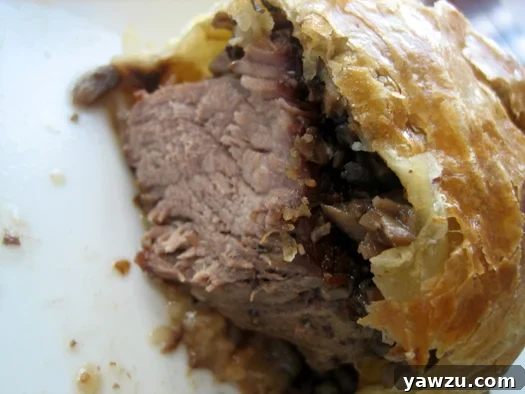
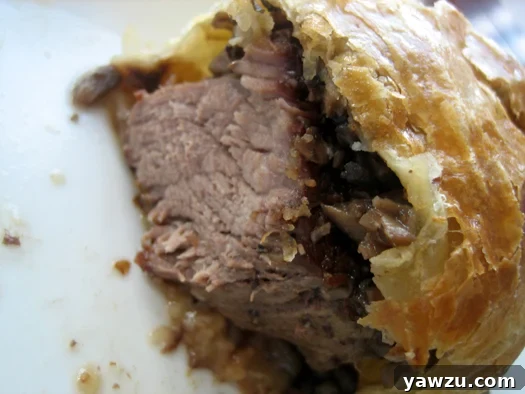
When preparing Beef Wellington, precision is paramount, especially when it comes to the doneness of the beef. You might notice that in some photos, the filet appears slightly more well-done than a typical medium-rare filet mignon. This was not entirely intentional in my initial attempt. The times provided in most recipes aim for a perfect medium-rare, and because I generally prefer my steaks closer to medium, I added an extra minute of searing per side and maintained the suggested baking time. This resulted in a slightly firmer texture, which, while still delicious, taught me a valuable lesson.
The key takeaway is to always monitor your beef’s internal temperature with a reliable meat thermometer. Every oven is different, and the thickness of your filets will greatly influence cooking times. For a medium-rare finish, aim for an internal temperature of 130-135°F (54-57°C) before resting. For medium, target 135-140°F (57-60°C). Even with a slightly more done interior, the magic of the duxelles and puff pastry ensures the meat remains incredibly moist and flavorful, a testament to the dish’s ingenious design.
Serving Your Culinary Triumph
The reward for your efforts is a truly fabulous meal that tastes every bit as impressive as it looks. Served alongside classic complements like creamy garlic smashed potatoes and vibrant green beans, it becomes a complete and satisfying feast. The contrast between the crisp pastry, tender beef, and comforting sides is simply divine. It’s the kind of meal that makes a special occasion feel even more extraordinary, and it certainly allowed me to proudly cross Beef Wellington off my personal “Top 100” culinary list!
Beyond these traditional accompaniments, consider enhancing your Beef Wellington experience with a rich red wine reduction, a side of roasted asparagus, or even a light, peppery arugula salad to cut through the richness. A good bottle of Cabernet Sauvignon or Merlot would also be an excellent pairing, complementing the deep flavors of the beef and mushrooms.
Now, let’s get to the recipe, so you can embark on your own journey to mastering this iconic dish.
Individual Beef Wellington
4
servings
30 minutes
30 minutes
1 hour
Pin
Ingredients
-
4
thickly cut filet mignons, (6-ounce ) -
1 teaspoon
salt -
½ teaspoon
(0.5 teaspoon)
freshly ground black pepper -
1 tablespoon
olive oil -
4
slices goose or duck liver, or pork country-style pate, (1-ounce ) -
8.6 ounces
(243.81 g)
frozen puff pastry (1 sheet), thawed -
Mushroom Duxelles, recipe follows -
1
large egg beaten with 2 teaspoons water to make an egg wash
Mushroom Duxelles:
-
1 tablespoon
unsalted butter -
2 tablespoons
minced shallots -
½ teaspoon
(0.5 teaspoon)
minced garlic -
10 ounces
(283.5 g)
button mushrooms, wiped clean, stemmed, and finely chopped -
¼ teaspoon
(0.25 teaspoon)
salt -
⅛ teaspoon
(0.13 teaspoon)
freshly ground white pepper -
2½ tablespoons
(2.5 tablespoons)
dry white wine
Instructions
-
1
To make the Mushroom Duxelles: Heat the butter in a medium skillet over medium-high heat. Add the shallots and garlic and cook, stirring, for 30 seconds. Add the mushrooms, salt, and white pepper, reduce the heat to medium, and cook, stirring, until all the liquid has evaporated and the mushrooms begin to caramelize, about 12 minutes. Add the wine and cook, stirring to deglaze the pan, until all the liquid has evaporated. Remove from the heat and let cool before using. -
2
Preheat the oven to 425 degrees F (220 degrees C). Line a baking sheet with parchment paper and set aside. -
3
Season both sides of each filet with ¼ teaspoon of the salt and 1/8 teaspoon of the pepper. -
4
Heat the oil in a large heavy skillet over medium-high heat. Add the filets and sear for 1 minute on each side for medium-rare. Transfer to a plate to cool completely. -
5
Roll out the puff pastry on a lightly floured surface to a 14-inch square, and cut into 4 (7-inch) squares. -
6
Spread one-quarter of the mushroom duxelles on top of each filet and top each with 1 slice of the pate (if using), pressing to flatten. Place one filet, mushroom side down, in the center of a puff pastry square. Using a pastry brush or your finger, paint the inside edges of the pastry with egg wash. Fold the pastry over the filet as though wrapping a package and press the edges to seal. Place the packages seam-side down on the prepared baking sheet. Brush the egg wash over the tops and sides of each package and bake until the pastry is golden brown and an instant-read thermometer registers 140 degrees F (60 degrees C) for medium-rare, about 20 minutes. -
7
Remove from the oven and let rest for 10 minutes before serving. This crucial resting period allows the juices to redistribute, ensuring a tender and moist filet.
Calories:
923
kcal
,
Carbohydrates:
35
g
,
Protein:
39
g
,
Fat:
68
g
,
Saturated Fat:
23
g
,
Cholesterol:
167
mg
,
Sodium:
1016
mg
,
Potassium:
811
mg
,
Fiber:
1
g
,
Sugar:
2
g
,
Vitamin A:
145
IU
,
Vitamin C:
1.9
mg
,
Calcium:
24
mg
,
Iron:
6.4
mg
Did you make this recipe?
I’d love to see your culinary creations! Share your experience by leaving a review below. Don’t forget to snap a picture and tag @thebrowneyedbaker on Instagram so I can admire your beautiful Beef Wellington!
Michelle Lettrich
Main Course
American