How to Make Homemade Fresh Pasta: A Step-by-Step Tutorial
There’s a certain magic that fills the kitchen when homemade pasta is being prepared. While my grandma, a culinary purist, would never dream of using store-bought spaghetti sauce – considering those brand names practically sacrilege – it wasn’t uncommon to find boxes of dried pasta in her pantry. Yet, those special Sundays, when we’d arrive after church to find her countertops adorned with towel-lined baking sheets, each cradling delicate nests of freshly made pasta, were truly unforgettable. The aroma alone was enough to transport you to the heart of Italy, right there in her bustling kitchen.
Making fresh pasta at home isn’t just about the food; it’s about connecting with tradition, savoring simple ingredients, and creating an experience. The unparalleled taste and texture of homemade pasta elevate any meal, transforming an ordinary weeknight dinner into a special occasion. If you’ve ever been intimidated by the idea of making pasta from scratch, let me assure you: it’s far simpler than you might imagine, requiring just two core ingredients and a little bit of love.
The Joy of Homemade Pasta: Why It’s Worth the Effort
For many, the thought of making pasta from scratch might seem daunting, conjuring images of professional chefs in bustling trattorias. However, the reality is that crafting your own pasta dough at home is an incredibly rewarding experience that offers numerous benefits:
- Superior Taste and Texture: Fresh pasta has a tender, delicate texture and a richer flavor that dried pasta simply can’t replicate. It absorbs sauces more beautifully, creating a more harmonious dish.
- Control Over Ingredients: When you make your own pasta, you know exactly what goes into it. No artificial preservatives or additives—just pure, simple goodness. This is especially appealing for those with dietary restrictions or who prefer organic ingredients.
- A Therapeutic Process: The act of kneading dough, feeling it transform under your hands, and then rolling it into delicate sheets can be incredibly meditative and satisfying. It’s a wonderful way to unwind and engage with your food.
- An Impressive Skill: Serving homemade pasta always impresses guests. It shows care, dedication, and a passion for good food that truly shines through in every bite.
- Versatility: Once you master the basic pasta dough, a world of possibilities opens up. You can create various shapes for different dishes, from delicate tagliatelle to hearty lasagna sheets, or even stuffed pastas like ravioli and tortellini.
The last time I made fresh pasta was almost six years ago for a delightful fettuccine alfredo dish. It’s hard to believe how much time has passed! I was definitely overdue for dusting off the pasta rollers and experiencing that unique satisfaction again. Truth be told, homemade pasta is not difficult at all, and its magic lies in its simplicity.
Essential Tools for Your Pasta Journey
While the process of making pasta is straightforward, having the right tools can make it even more enjoyable and efficient. You have a couple of excellent options for rolling out your dough:
- Traditional Hand-Crank Pasta Machine: This classic tool is what many grandmothers used, and for good reason. It’s reliable, durable, and offers a hands-on experience that connects you to the culinary traditions of the past. I’ve used one both at my grandma’s house and during my first solo pasta-making adventure. They are affordable and don’t require an electric mixer. You simply clamp it to your counter and feed the dough through, gradually decreasing the thickness setting. Many quality models are available, and they often come with attachments for cutting different noodle shapes.
- KitchenAid Pasta Roller Attachment: If you own a KitchenAid stand mixer, their pasta roller attachment is a fantastic investment. It attaches to the power hub of your mixer, allowing the machine to do the heavy lifting of rolling, leaving your hands free to guide the dough. This is what I used for this tutorial, and it makes the process incredibly smooth and consistent.
- Rolling Pin (for the purists): While more labor-intensive, a good old-fashioned rolling pin can also be used to roll out pasta dough. This method requires more elbow grease and patience to achieve an even thickness, but it’s a perfectly valid and traditional way to make pasta if you don’t have a machine.
While some people opt to use a mixer for making the dough itself, I prefer to do it the way I remember seeing my grandma make it on her big wooden dough board. There’s something deeply satisfying about feeling the ingredients come together with your own hands – a large mound of flour, creating a perfect well in the middle, cracking the eggs directly into it, and then meticulously mixing it all up. This traditional method served her well her entire life, and as the old adage goes, “if it’s not broke, don’t fix it.”
Having prepared a phenomenal meat sauce yesterday, today we are focusing on crafting the perfect fresh pasta to accompany it. I promise you, the combination of homemade pasta and a rich, slow-simmered sauce is going to be fan-freaking-tastic!
Now, let’s get this homemade pasta party started!
DIY: How to Make Fresh Pasta
Pin Recipe
Rate Recipe
Ingredients
- 2 cups (250 g) all-purpose flour
- 3 large eggs
Instructions
-
1. Prepare Your Work Surface: On a large, clean work surface (like a clean countertop or a dedicated dough board), place the all-purpose flour. Gather the flour into a neat mound, then create a substantial well in the center, ensuring the walls are high enough to contain the eggs without spillage. This traditional method is not only effective but also quite satisfying.
2. Mix the Dough by Hand:
-
Crack the eggs directly into the center of the flour well. Using a fork, gently and lightly beat the eggs until they are thoroughly broken up and well combined. Be careful not to break the flour walls at this stage.
-
Gradually begin to incorporate the flour into the eggs. Work from the inside of the mound, slowly drawing small amounts of flour into the egg mixture with your fork. Continue this process, maintaining the “walls” of the flour mound for as long as possible to prevent the egg from spilling out. As the eggs absorb more flour, the mixture will thicken.
-
Once nearly all the flour has been incorporated into the eggs, the mixture will appear very rough and shaggy, resembling coarse crumbs or a thick paste. This is normal and means it’s time to get your hands dirty!
-
3. Knead the Dough: Begin working the shaggy mixture with your hands. Gather it all together and start kneading the dough on your work surface, much like you would bread dough. Push it away from you with the heels of your hands, then fold it back over and turn it slightly. Continue kneading vigorously for about 7 to 10 minutes. The dough will gradually transform from a sticky, uneven mass into a smooth, elastic, and pliable ball. It should feel firm but yielding, no longer sticky, and should spring back slowly when poked.
-
4. Rest the Dough: This step is crucial for developing the gluten and relaxing the dough, making it easier to roll. Cover the kneaded dough ball tightly with a piece of plastic wrap, or place it in an airtight container. Allow it to rest at room temperature for at least 15 minutes, or up to 2 hours. This resting period allows the flour to fully hydrate and the gluten to relax, resulting in a more tender and manageable pasta.
-
5. Divide the Dough: After resting, unwrap the dough. If you are making filled pasta (like ravioli or tortellini) or large sheets for lasagna, cut the dough into four equal pieces. For thinner noodles like fettuccine or spaghetti, cut the dough into eight equal pieces. Keeping the pieces smaller makes them easier to handle and roll.
-
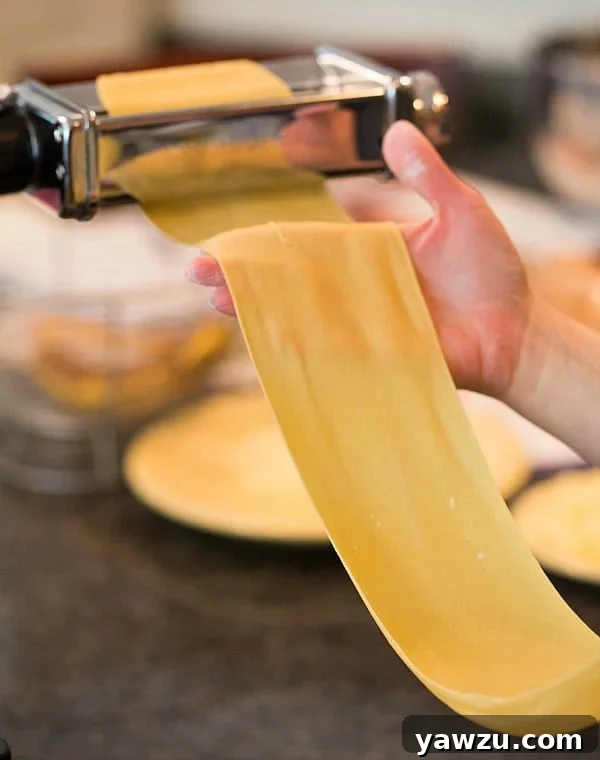
6. Roll the Pasta Sheets (Initial Pass): Work with one piece of dough at a time. It’s essential to keep the remaining pieces covered with plastic wrap or a damp towel to prevent them from drying out, which can make them difficult to work with. Flatten the piece of dough into an oblong shape, then carefully pass it through your pasta machine on the widest setting (this is usually setting #1). This first pass helps to shape the dough and begin the rolling process.
-
7. Fold and Re-Roll for Strength: Lightly dust the rolled dough sheet with a minimal amount of flour to prevent sticking. Then, fold the dough into thirds, as you would a letter. This folding and re-rolling step strengthens the gluten structure and ensures a smooth, even sheet of pasta.
-
Pass the folded dough through the pasta machine’s widest setting again, making sure to feed the open side of the dough through first. Repeat this process one more time, for a total of three passes through the widest setting, folding into thirds each time. You should now have a smooth, rectangular piece of dough.
-
8. Gradually Thin the Pasta: If the dough feels at all sticky, lightly dust it with flour again, but avoid over-flouring. Adjust the pasta machine setting to the next level (typically #2), which is slightly narrower. Pass the dough through this setting two times.
-
9. Achieve Desired Thickness: Continue to roll the pasta thinner by progressively passing it through the machine, decreasing the setting by one level for each subsequent pass. For most pasta types, you’ll pass it through each setting once, or twice if needed for extra smoothness. The ideal final thickness depends on the type of pasta you are making:
- Filled Pasta (Ravioli, Tortellini): Roll to the thinnest setting (usually #6 or #7) to ensure the pasta is delicate and cooks quickly, allowing the filling to shine.
- Lasagna Sheets: End on the next-to-thinnest setting (usually #5 or #6) for sturdy yet tender layers.
- Noodles (Fettuccine, Spaghetti, Tagliatelle): Also end on the next-to-thinnest setting (typically #5 or #6). This provides a good balance of chewiness and tenderness.
-
10. Prepare for Cutting or Immediate Use: As you finish rolling each pasta sheet, lay it flat on a clean dish towel that has been lightly dusted with flour.
- For Lasagna or Filled Pasta: If you plan to use the sheets immediately for lasagna or to make filled pasta, cover them with another slightly damp dish towel. This prevents them from drying out and cracking while you prepare your fillings or assemble your dish.
- For Noodles: If you intend to cut the pasta into noodles, do not cover the sheets. Allow them to air-dry for 10 to 15 minutes, or until they are only slightly tacky to the touch. This slight drying prevents the noodles from sticking together when cut.
At this point, you can attach a fettuccine or spaghetti cutter to your pasta machine and run each sheet through to create uniform noodles. If you prefer wider noodles, you can easily cut them by hand:
- Pappardelle: Cut into strips ¾ to 1 inch wide.
- Tagliatelle: Cut into strips ¼ to ⅜ inch wide.
-
11. Storage and Cooking:
- For Immediate Cooking: Immediately transfer the fresh noodles to a baking sheet lined with a clean, flour-dusted dish towel. Separate individual strands as best you can to prevent clumping. Cover the noodles with a damp dish towel to keep them from drying out until you are ready to cook them. Fresh pasta cooks much faster than dried pasta, usually in 2-4 minutes in boiling, salted water.
- For Short-Term Storage (Dried Pasta): If you wish to store the pasta for future use, gather several strands as you cut them and gently curl them into small nests. Lay these nests on a clean, flour-dusted kitchen towel or a wire rack and allow them to air-dry completely for 24 hours at room temperature. Once fully dry and brittle, they can be stacked in an airtight container and stored in a cool, dry place for up to 2 weeks.
- For Long-Term Storage (Frozen Filled Pasta): Filled pasta, such as ravioli and tortellini, can be frozen. Place the individual pieces in a single layer on a baking sheet lined with parchment paper. Freeze until solid (about 1-2 hours). Once completely frozen, transfer them to a resealable freezer bag. They can be kept in the freezer for up to 1 month. Cook directly from frozen in boiling water.
Notes
Carbohydrates: 191g,
Protein: 42g,
Fat: 15g,
Saturated Fat: 4g,
Cholesterol: 491mg,
Sodium: 192mg,
Potassium: 449mg,
Fiber: 6g,
Sugar: 1g,
Vitamin A: 715IU,
Calcium: 111mg,
Iron: 13.9mg
Did you make this recipe?
Leave a review below, then snap a picture and tag @thebrowneyedbaker on Instagram so I can see it!
Tips for Perfect Homemade Pasta
Achieving consistently delicious homemade pasta comes with practice, but these tips will set you on the path to success:
- Don’t Over-Flour: While flour is essential to prevent sticking, too much flour can make your dough dry, crumbly, and tough. Use just enough to keep the dough manageable.
- Keep Dough Covered: Uncovered dough dries out quickly, becoming brittle and difficult to work with. Always keep unused portions of dough tightly covered with plastic wrap or a damp towel.
- Knead Thoroughly: Proper kneading develops the gluten, which is essential for the pasta’s elasticity and texture. Don’t rush this step. The dough should be smooth and firm but still pliable.
- Resting is Key: Don’t skip the resting period! It allows the gluten to relax, making the dough much easier to roll thinly without tearing.
- Gradual Thinning: When using a pasta machine, always start on the widest setting and gradually decrease the thickness. Jumping too quickly to a thin setting can tear the dough.
- Cook Immediately or Dry Properly: Fresh pasta cooks very quickly. If not cooking right away, ensure it’s either fully covered (for same-day use) or completely dried (for storage) to prevent spoilage or sticking.
Common Troubleshooting for Homemade Pasta
Even experienced pasta makers encounter challenges. Here are solutions to common issues:
- Dough is too sticky: If your dough feels overly sticky after kneading, add a tiny bit more flour (about half a tablespoon at a time) and knead it in until the stickiness disappears.
- Dough is too dry/crumbly: If the dough is too dry and crumbly to come together or easily tears, add a teaspoon of water at a time and knead until it reaches a smooth, pliable consistency.
- Pasta sheets tear when rolling: This usually means the dough is too dry, wasn’t kneaded enough, or wasn’t rested long enough. Try re-kneading the dough for a few more minutes, adding a touch of water if necessary, and then resting it for another 15-30 minutes. Also ensure you are reducing the thickness settings gradually.
- Noodles stick together after cutting: This often happens if the pasta sheets were too moist when cut, or if they weren’t properly floured. Ensure sheets are slightly tacky, not wet, and lightly flour them before cutting. After cutting, spread them out on a flour-dusted towel to air dry for a bit before cooking.
Serving Suggestions: Pairing Your Fresh Pasta
The beauty of homemade pasta is how wonderfully it pairs with a variety of sauces. Here are a few ideas to inspire your next meal:
- Classic Marinara: A simple, vibrant tomato sauce allows the fresh pasta’s flavor to shine.
- Creamy Alfredo: Rich and decadent, an Alfredo sauce clings perfectly to the delicate strands of fresh fettuccine.
- Pesto: A fresh basil pesto, whether traditional or a nut-free variation, offers a burst of herbaceous flavor.
- Aglio e Olio: For something lighter, a simple garlic and olive oil sauce (Aglio e Olio) highlights the pasta’s texture.
- Butter and Sage: A truly simple yet elegant sauce, browned butter with fresh sage leaves is exquisite with delicate shapes like ravioli or tagliatelle.
- Bolognese or Ragu: A slow-cooked meat sauce, like the phenomenal one I prepared, is the ultimate comfort food pairing for hearty homemade pasta.
Embrace the Tradition
Making homemade fresh pasta is more than just cooking; it’s an experience, a tradition, and a delicious act of love. Whether you’re honoring family recipes or starting new ones, the process of transforming simple flour and eggs into tender, flavorful pasta is deeply satisfying. The superior taste and texture of fresh pasta will undoubtedly elevate your culinary adventures and bring a special warmth to your table.
So, roll up your sleeves, gather your ingredients, and immerse yourself in the delightful art of homemade pasta. Your taste buds, family, and friends will thank you!